Imaging AI is being adopted. But adoption alone does not tell the whole story.
According to a KLAS Research report, nearly 50% of organisations interviewed outside the U.S. were using at least one imaging AI solution, and those organisations collectively used 108 different AI vendors.
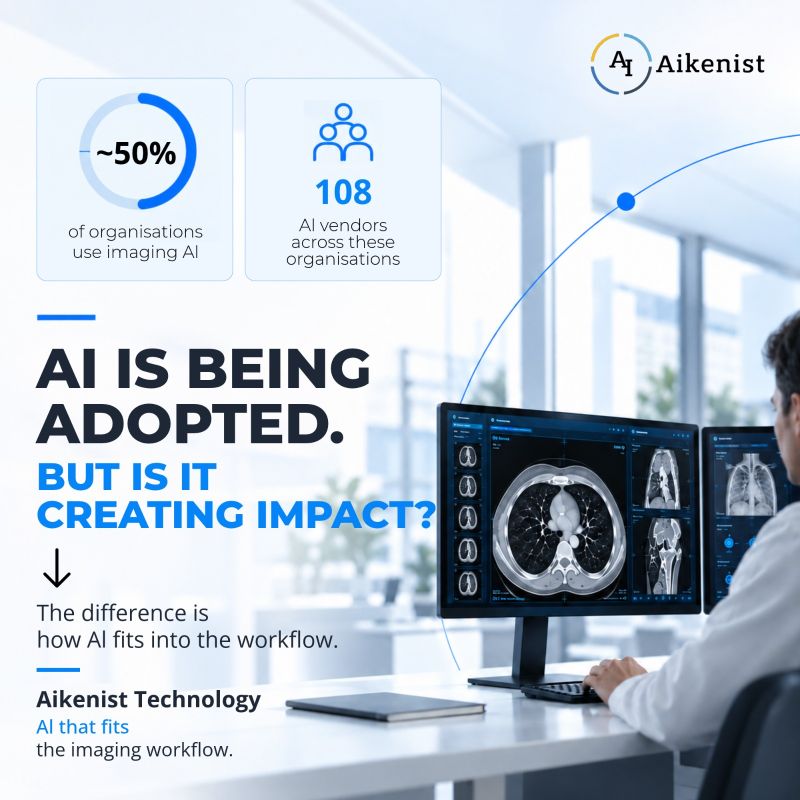
That tells us something important: AI is no longer just being explored in medical imaging. It is finding its way into real-world workflows.
The question after adoption
The next question is more important: what happens after adoption?
If AI operates as another standalone tool, it can add another interface, another handoff and another layer of complexity. Multiply that across many vendors and the burden lands on the clinicians who have to work around the technology.
The real value comes when AI becomes part of the workflow, helping the different stages of imaging work together rather than forcing clinicians to adapt to the software.
What workflow-integrated AI looks like
This is the approach we take at Aikenist. Across the imaging journey, QuickSuite brings the layers together:
- QuickScan for faster image acquisition.
- QuickDiag for AI-powered analysis.
- QuickRad for reporting.
- QuickFlow for connected workflow orchestration.
Our focus is on bringing intelligence closer to the way imaging is actually performed. The idea is to move from acquire, to manage, to analyse, to report, to share, within one connected ecosystem, with less switching between disconnected systems.
Questions to ask when evaluating imaging AI
If your organisation is adding AI, these questions can help separate a good model from a good fit:
- Does it appear where clinicians already work, or does it need yet another login and interface?
- How many handoffs does it add between acquisition, image management, analysis and reporting?
- Can its output be trusted, reviewed and corrected by the clinician?
- Does it integrate with your PACS and RIS through standard DICOM?
- Does it reduce repetitive work without adding complexity?
It's about fit
In radiology, AI impact is not only about what the technology can do. It is about how well it fits into the work.
Frequently asked questions
How widely is AI used in medical imaging?
According to a KLAS Research report, nearly 50% of organisations interviewed outside the U.S. were using at least one imaging AI solution, collectively using 108 different AI vendors.
Why can standalone imaging AI tools create problems?
A standalone AI tool can add another interface, another handoff and another layer of complexity to the radiology workflow, instead of helping the stages of imaging work together.
What does workflow-integrated imaging AI mean?
It means AI that becomes part of the imaging workflow, supporting acquisition, image management, analysis, reporting and sharing in one connected flow, so clinicians do not have to work around the technology.
What is Aikenist QuickSuite?
QuickSuite is Aikenist's connected ecosystem for the imaging journey. It combines QuickScan for acquisition, QuickDiag for AI analysis, QuickRad for reporting and QuickFlow for workflow orchestration.
Source: KLAS Research report on imaging AI adoption, as cited above.
Product capabilities are described as stated in Aikenist's product documentation; availability and regulatory status vary by product and region. QuickSuite is intended for use by, or under the supervision of, licensed healthcare professionals only.