The cost of running an MRI is not just the cost of the machine.

MRI infrastructure comes with a wider operational equation, and every part of it affects how many patients a department can actually scan:
- Helium supply pressures can create additional challenges for MRI operations.
- Maintenance and service requirements affect scanner availability.
- Long scan times limit the number of patients a machine can accommodate.
- Growing imaging demand makes utilisation increasingly important.
Recent reporting from India has highlighted concerns around helium availability and its potential impact on MRI services, while the Radiological Society of North America (RSNA) has previously noted the finite nature of helium and its importance in keeping superconducting MRI magnets operational.
The question to ask before buying another scanner
That raises a more important question: before adding another MRI, can we make better use of the capacity we already have?
Of the four pressures above, scan time is the one a hospital can influence directly. Every minute taken off a protocol is a minute that can go to the next patient on the list. This is where AI-accelerated acquisition becomes interesting.
How AI-accelerated MRI acquisition works
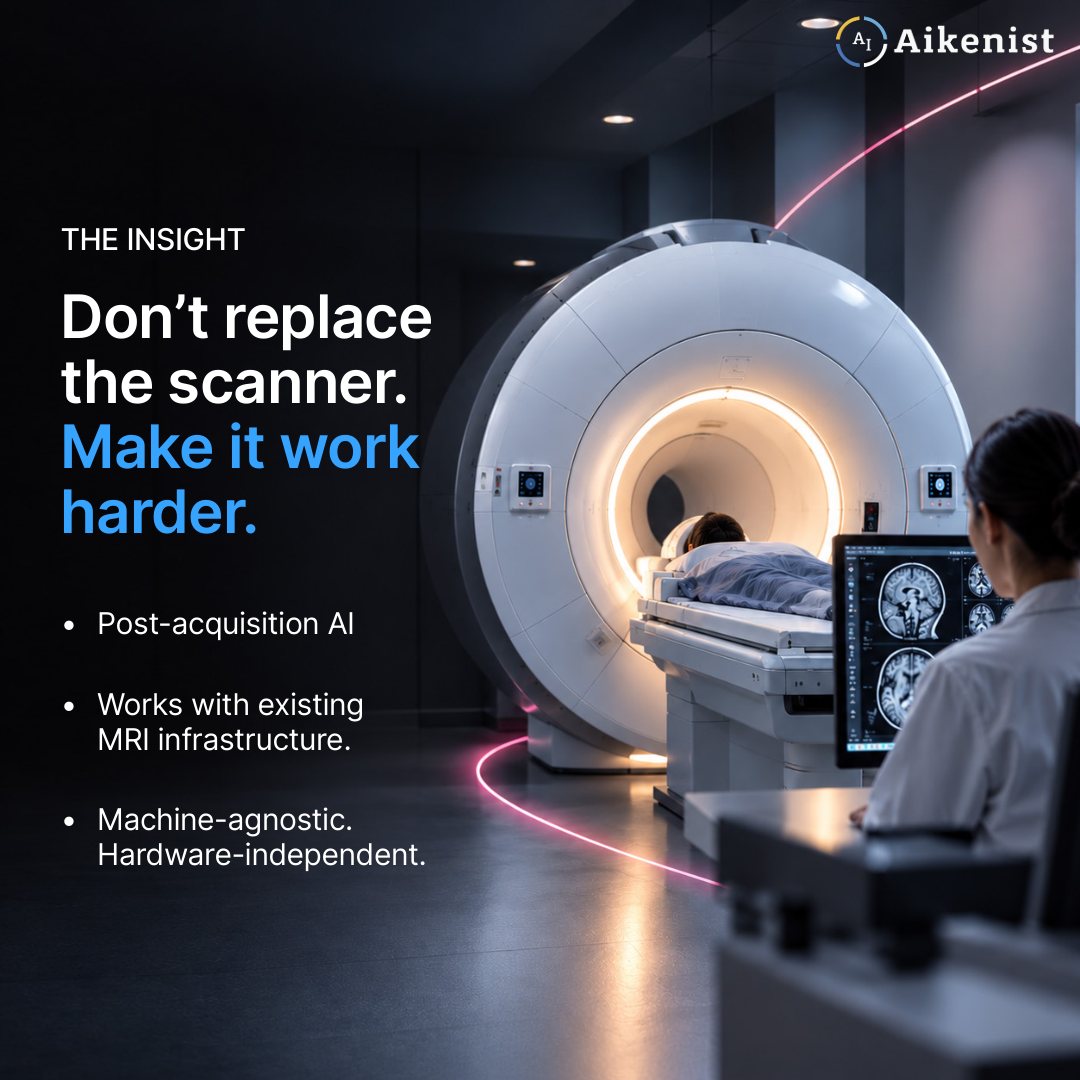
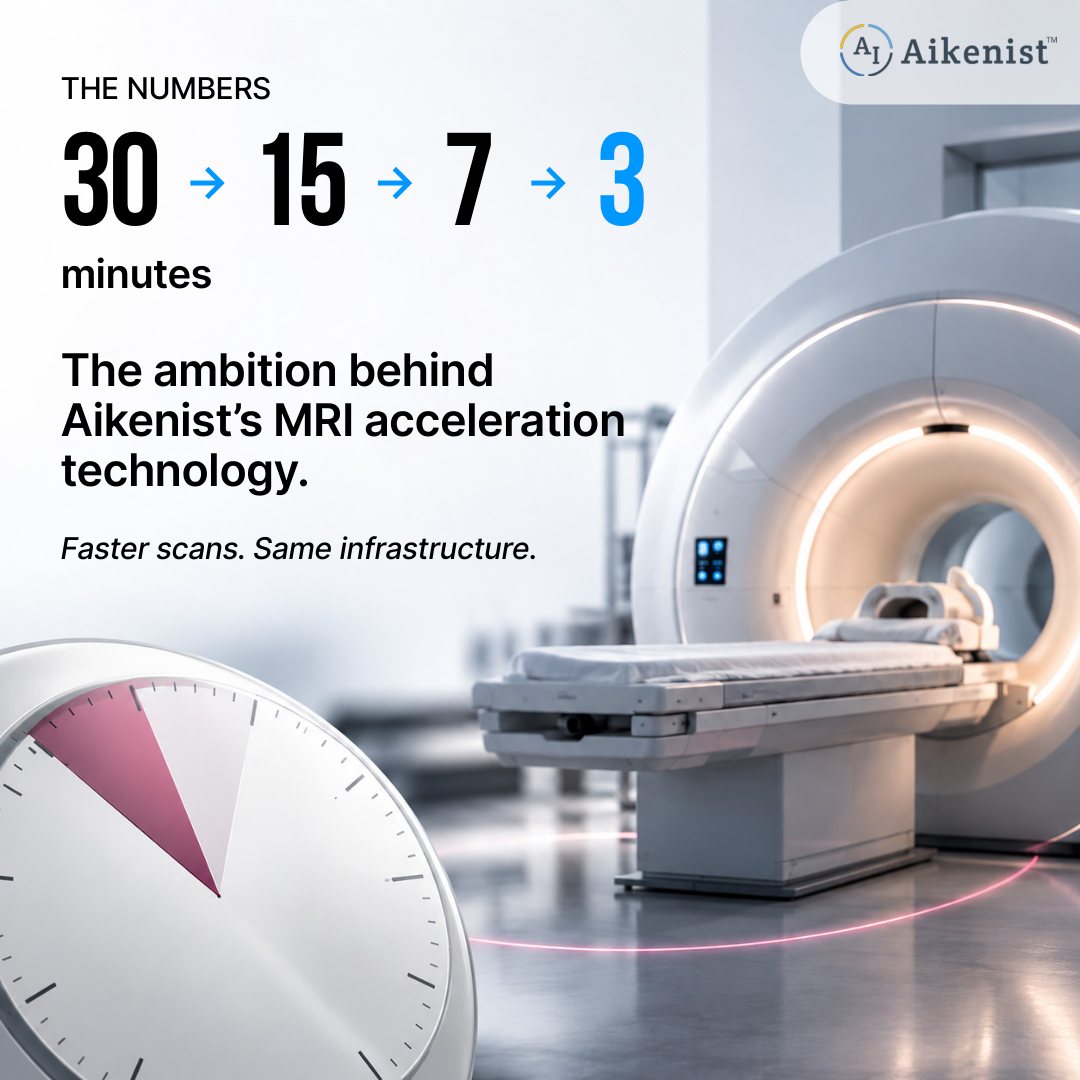
Aiken QuickScan is designed to accelerate MRI acquisition with AI. Aikenist states that it can enable up to 4x faster scan protocols without requiring new hardware. In Aikenist's own example, a 20-minute scan is reduced to 5 minutes.
As Ashwin Amarapur of Aikenist puts it: "The machine can scan faster, but the bottleneck is reconstruction." That is where AI comes in.

In outline, the workflow is:
- Faster acquisition: the scanner acquires undersampled data in a reduced scan time.
- Transparent interception: QuickScan intercepts the DICOM data stream at the scanner's reconstruction node, so the existing workflow is not disrupted.
- AI reconstruction: a deep learning model reconstructs full-resolution images from the undersampled data.
- Standard output: the enhanced images are delivered to PACS in standard DICOM format, ready for reading.
QuickScan is software-only, can be deployed on-premise at the scanner or through secure cloud infrastructure, and supports both 1.5T and 3.0T systems. Aikenist states compatibility with 95% of scanners across the major manufacturers, including Siemens, GE, Philips and Canon.
From faster scans to more capacity
The opportunity is not simply about scanning faster. It is about a chain of effects:
More efficient utilisation, greater capacity, reduced backlog, better patient access.
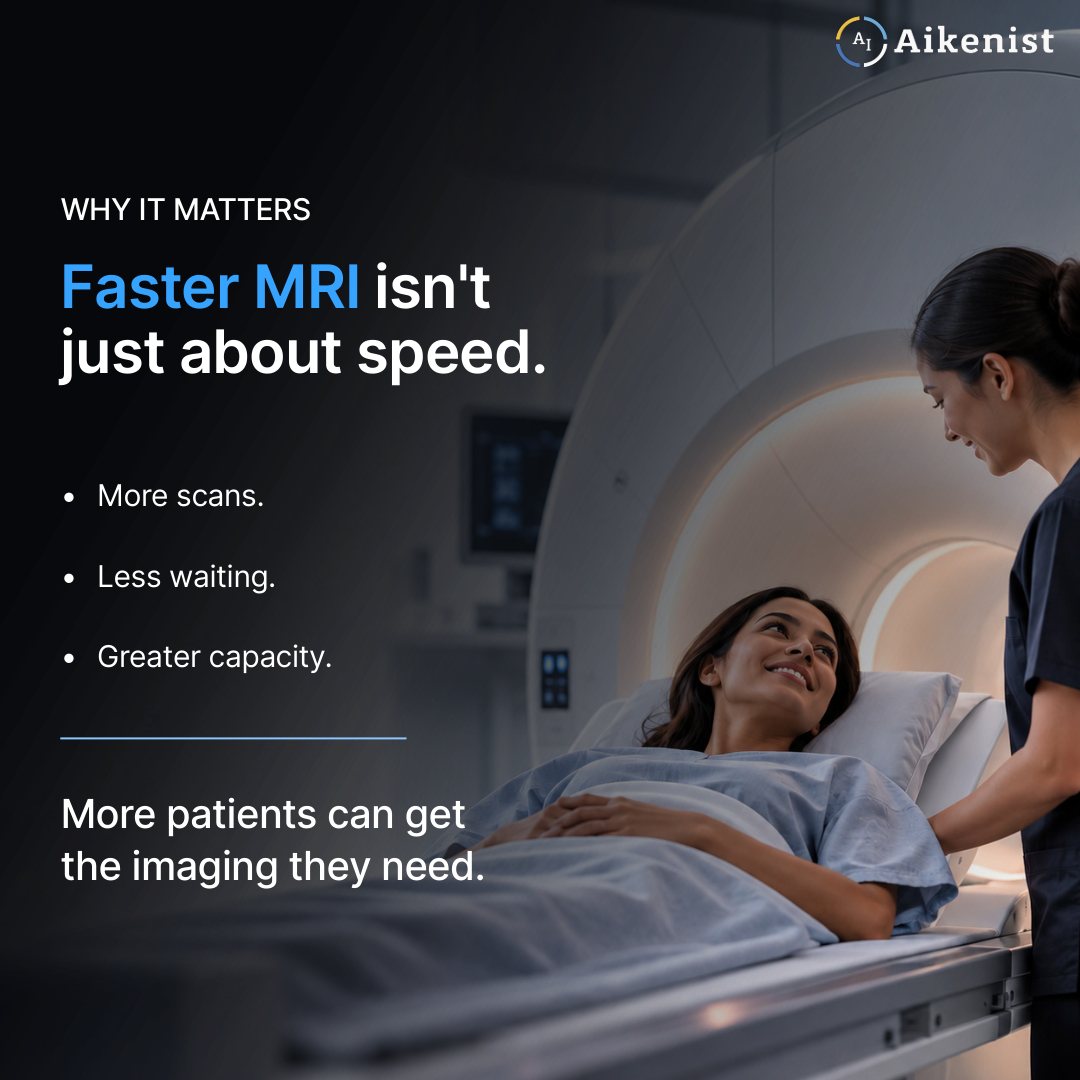
When MRI demand keeps growing, the next unit of capacity may not always have to come from another machine. Sometimes it can come from making the machine you already have work smarter.
Beyond the scan: the whole imaging workflow
Faster acquisition is only one part of the picture. The goal is faster scans with faster reporting, so patients can leave with answers sooner. That means looking beyond the scan and improving the entire imaging workflow.
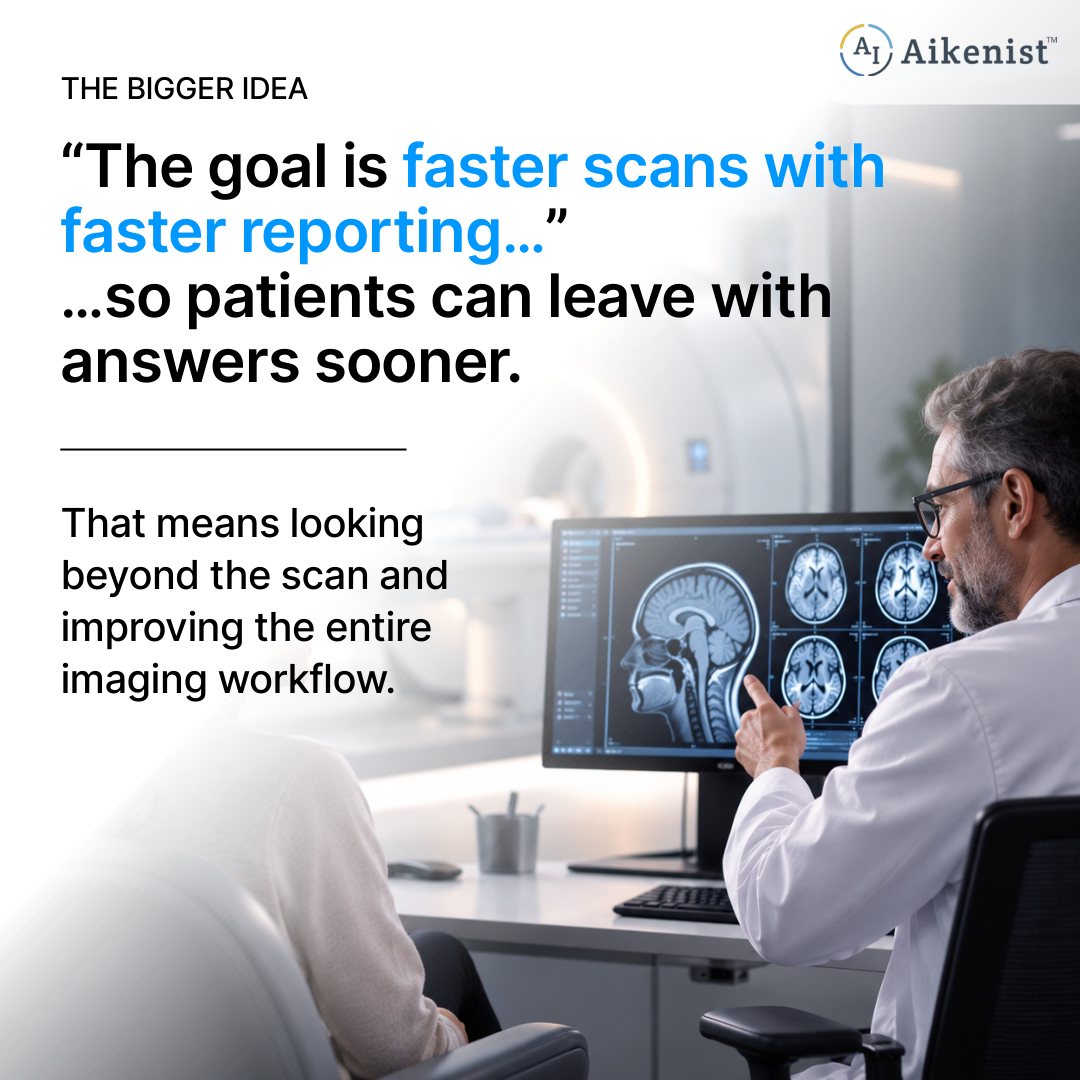
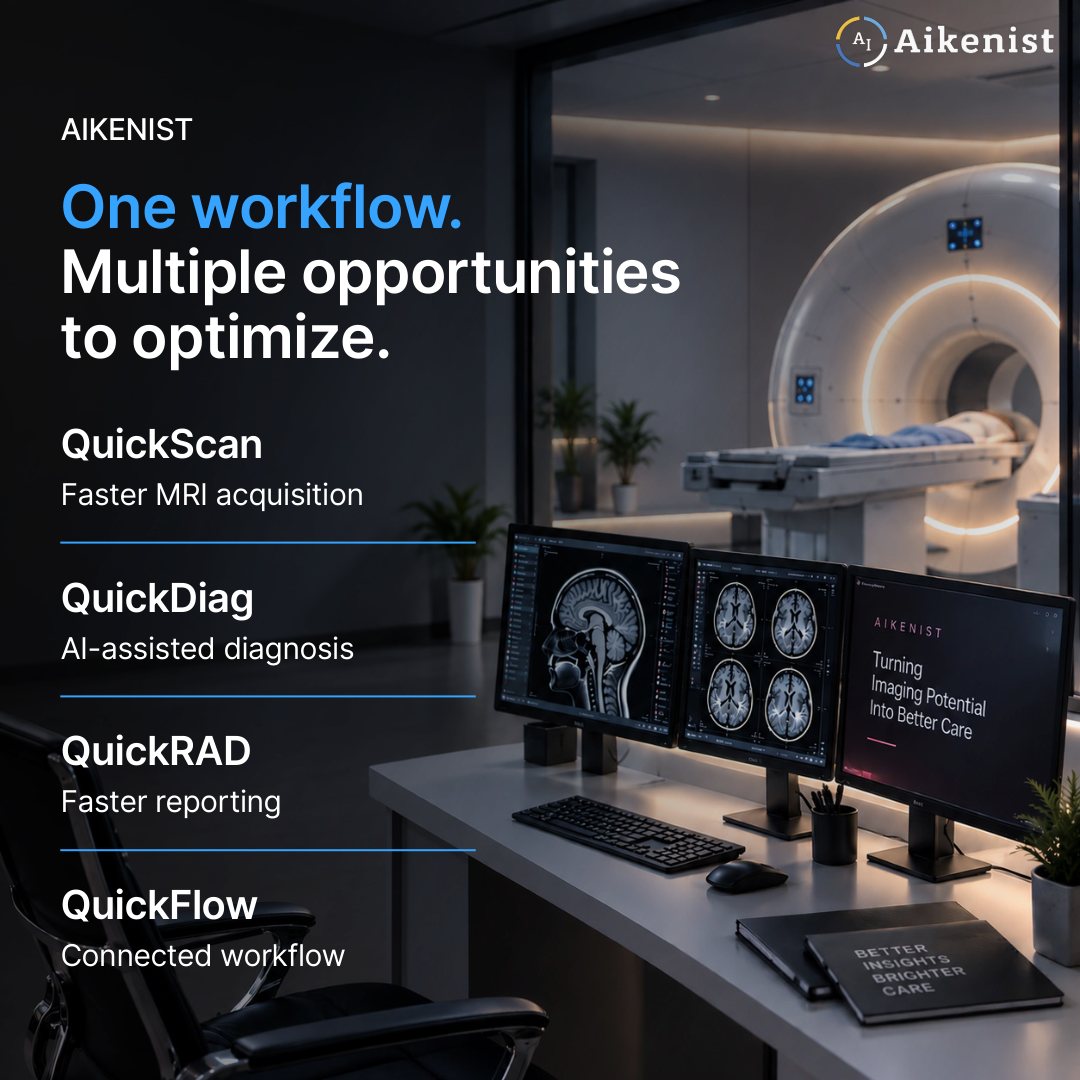
Across one workflow there are multiple opportunities to optimise:
- QuickScan: faster MRI acquisition.
- QuickDiag: AI-assisted diagnosis.
- QuickRad: faster reporting.
- QuickFlow: connected workflow.
What to look for in MRI acceleration software
If you are evaluating this kind of technology, a few practical questions help:
- Does it work with your scanner models and field strengths, without hardware changes?
- Is image quality maintained, and can your radiologists validate it on your own protocols?
- Does it integrate with your existing PACS, RIS and teleradiology workflow through standard DICOM?
- Can it be deployed on-premise or in the cloud, to suit your IT policies?
The future of MRI may not need more machines. It may need smarter ways to use the ones we already have.
Frequently asked questions
Does AI MRI acceleration software need new hardware?
No. Aiken QuickScan is a software-only deployment with no hardware modifications. Aikenist states it supports 95% of scanners across all major manufacturers.
How much faster can MRI scans be with QuickScan?
Aikenist states that QuickScan enables up to 4x faster scan protocols, for example a 20-minute scan reduced to 5 minutes. Actual results depend on the scanner and protocol.
Does a faster MRI scan mean lower image quality?
QuickScan uses AI reconstruction and enhancement designed to maintain image quality while reducing scan time. As with any new acquisition protocol, radiologists should validate results on their own scanners and sequences.
Which MRI scanners does QuickScan work with?
QuickScan supports 1.5T and 3.0T scanners from all major manufacturers, including Siemens, GE, Philips and Canon, and integrates with PACS and RIS through DICOM.
Sources: recent reporting from India on helium availability; RSNA's earlier commentary on the finite supply of helium; Aikenist QuickScan product information.
Product capabilities are described as stated in Aikenist's product documentation; availability and regulatory status vary by product and region. QuickSuite is intended for use by, or under the supervision of, licensed healthcare professionals only.